Showing posts with label OTASS. Show all posts

Wednesday, April 22, 2015

30 Days Alone in the Wilderness


Less than a week to go and I head off into the wilderness. For 30 days, no less. I have spent time in the wilderness, but nothing that came close to this long. Shorter durations are easier. They tend to get over before full scale boredom sets in. Also, resources are at hand. If one spends four or five days, maybe a week out in the wilderness, food can be carried. Not three wholesome meals a day maybe, but enough to keep the hunger pangs away. But there is no way one can carry enough food to last for 30 days. Ultimately the transition has to be made to living off the land. And there is enough food out there. Not necessarily big game like deer or pigs or goats or such like, but enough small creatures to feed you for the day. Animals like rabbits or squirrels or even creatures like earthworms. The problem lies in catching rabbits or even birds. Trapping and snaring is an art that needs to be mastered and to be honest I am yet to reach that goal. Sure, I know some traps and some snares, but these 30 days will put that knowledge to the test. I am sure to get hungry and I want to see how my mind and body copes in such situations.

My more immediate concern is water. Or rather, potable water. During the 30 Days in Uttarakhand, my proposed campsite is next to a mountain stream. There is enough rains happening in the region now and the stream should be flowing with water. So the source is not a problem, and neither is the quantity. The worry is germs and bacteria and viruses and other nasties that come along with it. There are villages upstream and there are animals. With no sanitation to speak of, the river becomes the source of washing and cleaning. The water is mixed with human and animal faeces, a sure formula to contract stuff like diarrhoea, e-coli, etc. Stuff that can make me sick for a very long time. I will lose whatever fluids the body has and then lose energy, strength and the will to carry on. Good, clean drinking water is what my focus will be. One way to make dirty water drinkable is by boiling it. And that has been proven across the world, for centuries. The worry is the faeces will boil along with the water. Sure, a lot of them will get killed, but am I willing to take the chance to some of them braving the heat? Maybe I will. And then maybe I will distil the water in addition to boiling it, just to be doubly sure. Distilling takes time, but then out there, all I have is time.

I expect the days to be quite busy really. Wake up in the morning, gather some pine needles and brew some tea. Walk down to the river and clean up, maybe take a dip if the water is not freezing cold. Then go out replenishing the stock of firewood. It takes a lot of firewood to keep you warm on a cold night and it is no fun running out of wood in the middle of the night. Foraging for firewood can be extremely taxing work, physically and emotionally. But with a raging fire in front of the tent with your dinner sizzling over it makes the effort all worthwhile. It does get tiring after the first few days, but then what has to be done, has to be done.

After firewood collection is done, it is time to go foraging for food. Either plucked off the trees or checking the snares and traps laid the previous evening. Trapping and snaring is a game of chance, it is a game of luck and it is a game of numbers. First identify animal trails and then multiple traps on the trail in the hope that something will catch. I am not very good at deadfall traps, and these are the go-to traps for small game. I guess over thirty days I will become a lot more proficient in setting traps and snares. I do hope to make a meal out of pine bark though. Fortunately the campsite is in the middle of a pine forest and there will be a lot of pine bark around. And if there are dead and fallen trees around, chances are there might be the tasty wood grub treats. Of course, the campsite is next to a river and that provides an opportunity for fish. But then fishing in the stream will not be nearly as easy as walking in to the store and picking up the choicest. Without a fishing rod, hook, line or sinker as part of the kit, one will have to improvise.

Another apprehension is the weather. Though monsoons are still a couple of months away, the region is being hammered by incessant rain, hail and thunderstorms almost every day. The weather forecast predicts rain and thundershowers for almost the entire thirty day duration of my trip. All I have in terms of shelter material I am carrying is a small bivy tent and a tarp sheet. No sleeping bag, no blanket, nothing. The temperature is in the low teens and if the fire does not do its job, the nights will be quite uncomfortable. Cold from the earth, wind through the netting that makes up one side of my bivy tent and convection from all around. Being a minimalist effort, I am tempted to dump the bivy tent too to be able to make a good windproof and waterproof debris shelter, but I think I will take it along. Like I said, thirty days in the wilderness is a first for me and I like to have the fallback of the tent with me. I think I will be ok.

My body clock is completely out of whack. I am a night owl and generally go to bed when I hear the birds starting to chirp and a faint glow of pink colour the sky. In the wilderness, except for the campfire and a small torch, there will be no illumination. No books to read, no television to watch, no internet to browse, no mails to respond to. Come sundown, everything will go dark pretty soon. Dinner will be frugal at best and chances are that one will have to try and get to sleep around seven in the evening. Not something that I am used to. So sleep will be hard to come by. And once it does come, one will wake up in the middle of the night, after a full quota of sleep time one is used to. And then stay up waiting for dawn. That should make for an interesting experience.

The other thing that will take up some quality time will be practicing some necessary back country skills. Some that I am good at and then getting to refine them. Others that I suck at and trying to get better at it. There is also a friend who will be with me for the thirty days, hoping to pick up some tips and tricks.

Moreover, I am filming the entire experience. That should be fun. Tiring and frustrating, but fun. Go set the camera, walk back to position, film the clip, walk back to camera to shut it off. This is fine when the task being filmed is close to the camera. It just sucks when one has to capture a walk up or down the hill, for instance. Imagine having to walk down the hill to set the camera, then walk up again to the start point and then walk down again for the benefit of the camera. When you are fatigued, this really can suck. Wonder how I will react to this situation when the time comes to face it. Compromise on the shot or suck up and bear it? Only time will tell.

All this is daily living. But why am I out there in the middle of nowhere, without contact with the ‘civilised’ world? It is for a little bit of “me” time. I am going off to be alone, to introspect, to question myself, hopefully to find some answers. I am hoping that some of the onion skins will get peeled off over the thirty days and I will be able to find some relevant questions, if not the answers to those questions.

I am basically a person who likes to be cocooned within his own solitary world. I do not really look forward to human company. I am me and I am my best friend. Living in society does not always take kindly to this facet of an individual. That is one reason I am heading off for some alone time. Clean the mind, cleanse the soul, hopefully be able to discard external frills and luxuries. That is probably what this is all about. Primitive living. Living without the luxuries, comforts and necessities that we take for granted. Food from the stores, the grid for electricity, air conditioner for comfort, a vehicle for travel, the oven to cook food. When it really comes down to it, how much of the creature comforts are really required and how little do we actually need? Can we make the transition from the need and greed that epitomises our materialistic society to a life that transcends that?

There will be some food that will be a part of my kit. Basically some rice and some dal. But that will run out one day. If one were to make a long term stay possible, one would have to necessarily live off the land. Plants and animals for food. Will I be able to make that transition? That is one question I am seeking the answer to. Will I miss watching soaps on television? Will I miss social media, the updates, the postings, the Likes and the Shares and the Comments? Will I miss watching movies? Will I miss that crazy old dude who cuts me off on the road? The chatter of the marketplace? The cacophony of city life? Or will I become habituated to the slow pace of life? Get used to listening to the birds? Take comfort in the sound of the gurgling stream? Sleep when I want to. Eat what I can find. Have the fire to talk to. Will I welcome visitors during the 30 days or will I view it as an infringement on my private space? I do not have the answers. I have some idea about how I want to react and feel, but not having been exposed to that reality yet, I do not really know which way the fork in the road will take me. I know one thing for sure, I am looking forward to the next thirty days, if nothing else but the alone time I hope to get.

By the way, the next sojourn into the wilderness is scheduled for September 2015, in the jungles of Arunachal Pradesh. I am looking forward to that one too. Truly speaking I want to spend thirty days in the wilderness every couple of months or so. The planning has already started. Arunachal Pradesh is the next. Maybe Sunderbans after that. Maybe a deserted island in the Andaman next year some time. The target is to do one thirty day wilderness experience in the Yukon towards the summer of 2016. Yukon, that’s in northwest Canada and I will be in the middle of some 70,000 grizzlies, a thousands of moose, wolves, wolverines and a whole lot more. For some reason, I have a feeling that the Yukon will be a very rewarding experience.

Anyway, so much for gazing into the future. The first one starts a few hours from now. I hope that turns out to be as exciting and pleasant as I hope it will be. Stay tuned, pictures and videos will come up soon.

Oh yeah, and do wish me Godspeed.

Thursday, December 11, 2014

Be Prepared or Be Scared


One acronym is quite common across the world, particularly in the United States. And that is SHTF. It stands for Shit Hits The Fan or for those a little more subtle, Stuff Hits The Fan. In India the more common term is Up Shit Creek Without a Paddle. People refer to getting into YOYO (You’re On Your Own) situations during TEOTWAWKI (The End Of The World As We Know It) when cities live WROL (Without Rule Of Law).

These are the preppers. The people waiting for Armageddon to strike. People who build nuclear shelters in their basements. Frankly, to many, preppers are crazy people. Nothing is going to happen. People have been predicting apocalypse for centuries and we are still here, aren’t we? Get a life people.

Yeah, sometimes preppers can go a little overboard. What started as a hobby turns into an obsession and instead of going for a holiday, the spare money is used up in stockpiling food and water and other gear. Prepping is a multimillion dollar industry worldwide ... and growing.

Most of these people, these preppers, live from paycheck to paycheck and usually there is a whole lot of month left at the end of the money, but hey, “I’m ready for the time when shit hits the fan. I do not want to become a zombie.” I personally do not agree with them though, at least not to the level they take their predictions to. Yes, they can be a little crazy and they do tend to be a little over the top with their doomsday predictions.

Then there is the other end of the spectrum. A way more crowded place. Those who refuse to take any precautions whatsoever. We will cross that bridge when we come to it. Many of these guys in the United States are Jews and Christians and obviously they have forgotten about the famous Ark that saved the world from extinction. Noah did not build the Ark when he felt the raindrops on his cheek becoming more frequent and closer together. Ok, Noah had his personal Met Department telling him that a storm was coming and he got right on the job and built his Ark and called his favourite couples on board, without too much favour or prejudice.

Yes, we have forgotten about Noah and his Ark.

But then we do have Noah and his team sitting in Government House, don’t we? What is it we elect them for if not to look after us when shit hits the fan. They better look after us when the storm knocks on my door. Ok, let us look at some facts.

Hurricane Katrina was a rude awakening to most US citizens – and Govt – regarding disaster preparedness. When citizens were refuged in the stadium it took the authorities of a first world country (some say the most powerful country in the world) FIVE DAYS to get water to those who were sheltered there. The 1999 Super Cyclone in Odisha killed almost 10,000 people officially. During Cyclone Phailin not a single person lost his or her life because of the precautions taken. Some say Phailin was potentially more devastating than Katrina. Lessons were learnt and action taken.

Odisha has got disaster response down to a fine art. They have the advantage of advance knowledge. They know a storm is building and when it will make landfall and where. They evacuate people, put them in storm shelters, activate all the emergency services, stock up on food and water and medicines and storm it out. Odisha officials are now travelling the world sharing their knowledge on how deal with a potentially catastrophic cyclone. I wonder if they are as prepared if there is a flood further inland in their State due to a storm that is happening in one of their Western neighbours. While eyes are looking out to sea, villages are washed away behind them. I am sure they have a system in place to handle those emergencies too.

But I am here not talking about what the Government can and should do in cases of natural disasters. When something big happens, like it did in Kedarnath or Srinagar or Gangtok or Bhuj or Latur or elsewhere, I am certain the Government will do its best.

I am talking about us, the common citizen, who are called the Mango Men and Women of India. What do we do be able to face, cope, handle, recover from a disaster? And not even a major disaster like the one in Kedarnath, but even one where there is no imminent danger of lives lost. A disaster such as a power outage because some dude sitting somewhere in the lawless boondocks of some country where citizens are non-State, mucks around with the computers and manages to remotely blow out the grid? What if the entire northern belt of the country (or really, even a single State, even a small one like Delhi) suddenly went black and no amount of flicking switches would bring the lights back on? Let us assume this situation lasts about five or six days before the lines get repaired and life starts to limp back to normal. What then? How will this affect our daily lives? Well, let us see. No electricity, right?

  • The lifts (or elevators) will stop working.
  • The motor (illegal of course) plugged into the municipal pipeline will not whir to life.
  • The motor (legal this time) will not have any water in the storage tank below to pump water to the storage tank on the roof.
  • When we twist the taps, no water will flow out.
  • When we press the button on the cistern lid, it will not flush out our shit.
  • Most establishments will run on generator power ... till the diesel/petrol/kerosene ran out.
  • The petrol stations will put up OUT OF STOCK signs.
  • With petrol stations out of stock, trucks will stop plying the highways and trains will stop in their tracks.
  • When trucks stop, there goes our source of daily vegetables, milk, meat, medicines, provisions (and for many people cigarettes and booze).
  • Store shelves will become empty of everything in the first few hours.
  • People will loot (and probably kill) for drinking water.
  • Large scale rioting will ensue and looters will vandalise shops, godowns, offices for anything they can lay their hands on.
  • Hospitals will not run since they will not have electricity ... or medicines.
  • People on life support systems will have to advance their Day of Judgement.
  • Sewage will pile up in the houses and garbage on the streets.
  • People dependent on prescription medicines will start to die ... diabetics for instance.
  • There will probably not be any decent funeral for the dead due to lack of electricity in the electric crematoria or lack of burning wood due to lack of freight transport.
  • The class difference between the beggars pre and post SHTF will start to disappear.
  • Sadly, some parents may start jumping out of windows with their babies because they can no longer bear the desperate cries of hunger.

What about the Government, I hear you ask, desperation and anger in your voice. The Government will become largely ineffective if this conditions lasts for more than a week or so, believe me. Because this ubiquitous entity called the Government comprises people too. Each and every moving element that makes the Government go round comprises people with families who are facing the very same issues that you are. The emergency services will start to disappear as things get more and more desperate, because however altruistic we might be, family will still come first. This goes for the Police, the Fire Services, the Hospitals, and that wonderful and eternal excuse - the administration. The only thing that will remain to be dug up and dusted later will be the other omnipresent entity, to be reviled, derided, cursed – THE SYSTEM.

I ask – What about your system? Sure, you want the Government to be prepared to face a catastrophic calamity and come to your rescue. My questions to you are:

  • What did YOU do to prepare for such eventualities?
  • Where were YOUR systems?
  • Are you happy to abdicate your responsibility as a father, mother, brother, sister, child, friend to an unknown and unreliable stranger, a collective of who form THE SYSTEM?

Delhi for instance has 398 policemen per 100,000 persons or about 250 people per policeman. So if you live in an apartment building with a thousand residents, four policemen will be able to:
(a) get everyone out of trouble,
(b) organise transport,
(c) help escort everyone to a safe place, and
(d) once deposited in a shelter, find food and water for everyone.

And while he is doing all this, he will also be called upon to tackle potential law and order issues, fix the transformer that resulted in this chaos in the first place, and take care of his own family.

Medical is yet another nightmare. There are less than TWO hospital beds for every 1,000 citizens of Delhi.

So, you still expect the Government ot come to your aid and rescue? Get real. Wake up and smell the coffee ... it just ain’t gonna happen. YOU HAVE TO PUT SYSTEMS IN PLACE FOR YOURSELF AND TAKE RESPONSIBILITY FOR YOU AND YOUR FAMILY.

We all like to quote Mahatma Gandhi – “Be the change you want to see in the world.” Why don’t you start with yourself? Take care of yourself. And if every citizen does that, the Government and the System can be left to do their jobs instead of mothering unprepared multitudes of citizens.

Yup, I think preppers are crazy. But I would rather be a little crazy (ok maybe a more than a little) and prepare for possible emergencies. I would not like to be the one walking the streets with a bowl looking for handouts to feed my hungry child. I will stock up with food, water and other basic necessary gear. Believe me, you do not need to spend a fortune to be prepared. It is more in the mind coupled with a little bit of money.


  • A 20kg bag of rice will feed a family of four for six months.
  • You can store drinking water for more than a year.
  • Reduce your dependence on the light bulb and the electricals.
  • Get a hand cranked radio so that you can gather information – the tv is out, remember?
  • Multitask stuff you find in your house – turn an empty can of beer into a stove, use dryer lint as tinder, a condom as a fire starter, the Sun as a clock, a couple of pencils and a thick book to make a trap to catch mice which you can eat by the way.

Be Prepared or you will be scared when the stuff hits the fan. Close your eyes and think back to the day a few weeks/months ago when the water did not gush through the taps. How desperate did you become? How long did it take for you to ration the available water in the house? Now think into the future and start stocking up. SHTF is happening, you just have your head buried in the sand. You do not learn to swim when the boat is sinking. YOU DO IT BEFORE YOU EVEN GET ON THE BOAT, in anticipation of such a thing occurring.

Be Prepared or Be Scared! Which one do you choose?

Monday, November 14, 2011

Tell me how to spend Rs 32 a day?

Over the past few weeks there has been a lot of talk among the chatteratti, the glitterati and the Fourth Estate, not to mention armchairs critics and harbingers of India’s future status, about the much quoted figure of Rs 32. A person who earns below this amount a day is considered living below the poverty line and most of the chatter is about how totally degrading and presumptuous this figure actually is. People are freely questioning the mental stability of the brains behind this figure. To many it is sacrilegious to even consider thinking about such a figure, let alone expecting people to take it for whatever it is worth and to base India’s future policies based on it. Many have tried to provide a break-up, albeit in a tongue in cheek fashion, of how this could be an amount a person can easily live off, every day.

Given that most of India lives in the villages and the avenues for conspicuous consumption are relatively non existent, I do not find this figure to be particularly revolting. I have tried to draw an analogy with one of the few things I profess to know about ... living off the grid. Consequently I have been trying not so much to try and live with less than Rs 32 a day, but trying to figure out ways and means of spending Rs 32 a day. Allow me to explain myself.

Living off the grid means that you are not dependent on the amenities and luxuries of the city. There are no electricity bills to pay, no gas to put in the tank, no LPG cylinder to cook your food. What does a person need not just to survive, but to live a relatively healthy and peaceful life? Three square meals a day, a roof over the head and clothes for vanity. OK, now to draw examples from living off the grid.

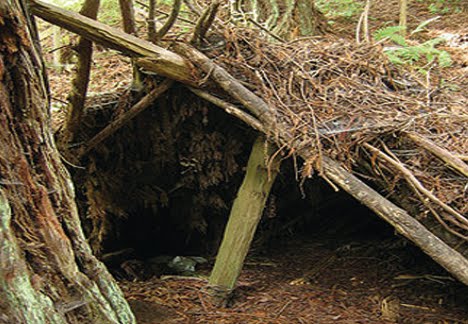
Let us take a roof over the head first. When one is living off the grid, one can devise a roof over the head using the materials Nature provides. All one needs is some logs, some branches, some leaves and some other natural vegetative debris that is always in abundance on the forest floor. Pine needles for a mattress, leaves for waterproofing and nice thick logs for protection. So shelter is done.

We come to three square meals a day. Actually one can learn to live on less than three squares a day, but let’s leave that debate aside for later. We eat too much in any case and all of us could do with a bit of moderation as far as food is concerned. Be that as it may, let us still look at three square meals a day. Nature provides for it in plenty. There are fruits on the trees, rice and wheat that you can grow, and animal protein in plenty. In the city we have conditioned ourselves to be right at the top of the food chain. In a self reliant situation, we are a part of the food chain. I am yet to meet or hear of a person ... or indeed any member of the animal kingdom ... who kills more than what is absolutely necessary to provide for the herd and family. This has been true ever since Plant Earth was inhabited by living creatures. It is we humans who like to stock up way more than what we require. There is food in plenty and no one in the wilderness need go hungry unless they are either infirm or old, therefore not fit enough to provide for himself or herself.

Along with food comes water. The human body comprises of two thirds part fluid and we cannot survive for more than a couple of days without water. As long as you are living off the grid with a water source close by and a means of making it potable, you are good to go. In fact, our bodies have become so immune to natural remedies that we cannot even think of ingesting even one drop of contaminated water. Over generations, and with increasing civilisation, we have tuned our bodies to be dependent of external healing. The natural process of healing has almost entirely been eroded.

That leaves clothes, the third pole of the Necessity Trinity. We need clothes to protect our privacy, to hide our shame, to prevent people from measuring lengths and cup sizes. But out there, living off the grid, who gives a flying f***. Even so, clothes are there to be tailored from animal skin. After all humans have worn animal skin clothes since the time of the first Neanderthals. Personally, clothes can be a bit of a luxury.

So, come to think of it, we do not really need a fancy house with a four car garage. We can do without the branded clothes, the fancy footwear and glittering eye glasses. And the jungle provides a four course gourmet meal if we are agreeable to becoming hunters, gatherers and chefs rolled into one.

Sure it will be difficult. But we can make life a lot easier by carrying our tents, our knives, our machetes, our fire starters, and a whole lot of stuff to help us do the things that need to be done in the jungle. But the tent will shred in time, the knives will blunt, the fire starters will get lost or outlive its utility. Then we are on our own. Hopefully by the time such a situation arises, one would have learned to make stone knives, stone tools, starting a fire by rubbing branches together and eating of a nice big flat piece of rock, which also acts as the hot plate on the camp fire.

After all this penning of thoughts, I am still not clear as to how I would manage to spend the allotted Rs 32 a day. OK, I will buy some seeds to grow my paddy and my rice and my potatoes. But after the first harvest I do not need to buy seeds either. If I can manage to live off the grid in an unfrequented area, not destroyed by previous agriculture, I will not need any fertilisers either for the farm. I would not need to rush to the store to pick up stuff. How do I spend Rs 32 a day living off the grid, pray tell.

And for those who say that one aspect I have entirely overlooked is educating the children, I have only one thing to say. I would rather have my children living off the land and respecting all living things, not destroying the environment by using a whole lot of polluting gadgets, not waste their time in frivolous and addictive activities like Facebook and email and blogging, they will grow up just fine. They will not crib about the air conditioner being on the blink or the rising price of oil. They will wonder why anyone would even consider bringing ‘democracy’ to a place that as a civilisation is thousands of years older than their own. All they need is an education is on frugality and in respect, for fellow living things, the environment and the planet we call home.

Someone do enlighten me on how to spend Rs 32 a day, every day. I will be obliged.

Monday, September 26, 2011

Would I rather be in a desert or a salt flat?

Interesting question. Both are deserts really. What is a desert? A desert is an area that receives extremely low rainfall. In fact, in many deserts, the water evaporated is more or faster than the amount of rainfall leading to arid areas which do not support the growth of plants or provide a habitat for animals. Well, not unless they are extremely adapted to those conditions and are truly hardy, able to survive in the unforgiving and harsh conditions. Negligible cloud cover, the sun’s rays beats down with relentless intensity, scorching the surface. And almost the moment the sun sets, bone numbing cold sets in. The difference in day and night temperatures in the desert can be nearly 50 degrees Celsius. Considering that only a fourth of the Earth’s surface is land, almost a fifth of that land mass comprises desert. Of course these include the polar deserts and the high mountains. So the chances of an adventurer finding himself or herself lost in either a desert or a salt flats is quite high.

Where I would rather be lost and find myself struggling to survive? Let us first look at what the two geographies have to offer.

The desert has almost no vegetation, almost no trees, some scrubs and bushes, intense temperatures, and most importantly, almost no water. The two things that kill in the desert are the intense heat and the lack of water. You can die in about a day, lost in the desert. The trick is to conserve your body fluids and internal moisture content, hunker down in a shade throughout the day, not move, not eat, and do all the walking and navigating at night when the weather is a lot cooler and the brain is not getting fried. It might still kill you though, the desert is unforgiving, almost with a vengeance.

Now if this was not harsh enough, what does a salt flat have in store? Everything that the desert has ... and more. Lesser vegetation than one can find in the desert for one. Which means no shade to talk about to sit and rest under. Sit? It is a salt flat. Meaning that the ground is full of salt. And most salt flats are wet and soggy. Which means trying to find a dry spot to sit becomes so much more, well, impossible. And even though the ground is wet, the water is not good to drink. You can die of dehydration faster by drinking salt water than not drinking any water at all. It takes two litres of fresh water to dilute one litre of salt water.

But compared to the desert, water is available ... salt water. And you can make a solar still to purify some drinking water to be able to stay hydrated. Inland salt lakes are often fed by fresh water rivers. If you know where you are lost and know the geography of the area, you might be able to head towards the river ... and rescue. In a salt lake fed by the sea, this option is not there.

The problem will be to find a place to rest and to find natural material to make a shelter. You will probably have to dig out some waterproof material from your pack to sit/lie on, and pull out some more stuff like a tarp sheet to build a roof to cut out the direct rays of the sun.

Both in the desert and in the salt flat, there is almost nothing to navigate to aid your journey forward, no distant trees to head for, or a hill or a lake or a pond or vegetation, nothing. The desert might have an undulating terrain, the salt flats none at all.

It is as difficult to walk on sand as it is to walk on slushy salt lake beds.

Suffice it to say, both are natural born killers, waiting like a spider for the fly to come into its parlour! But given a choice, where would I rather be lost? Tough question. Considering that water is life and even a cup of drinking water can mean one more night trying to get out of the problem, I think I would choose the salt flat.

But before I head anywhere near a salt flat, I will ensure that I am extremely well prepared in case I get into a survival situation. I will gear myself up with the tools that will help keep me alive. A couple of tarp sheets, a small tent, water containers, water purifying tablets, sun hat, goggles, good boots ... and a map of the area – printed as well as loaded on to my GPS.

Remember the 7 Ps of wilderness survival – Proper Planning Preparation and Practice prevents Possible problems. And when one is heading out consciously into a problem terrain, every grain of sand and every grain of dissolved salt, is a potential killer. Be prepared.

(The most famous of salt lakes/flats in India is the Rann of Kutch. A lesser known one is about 60 km northwest of Jaipur, the Sambhar Lake)

Friday, September 16, 2011

To eat or not to eat!!!

Hmmm, I have been struggling with this question for some time now. And no, I am not dieting or controlling obesity, far from it. The question has repeatedly burrowed out from the deep hole in the mind I had buried it in and refuses to lay in peace. OK, let me tell you what my worry is. It is about the OTA Survival School courses.

These are wilderness survival courses and participants need to have a survival experience. Meaning the course needs to be simulated to the extent that the participants actually feel they have survived the duration of the course and finally reached the safety and comfort of home. And it is only for two or three days in any case. My original plan was to provide major sleep, food and water deprivation to give them a feel of what it feels like to be sleepy, to be hungry, to be thirsty. A situation where they would go hungry if they could not catch food, thirsty if there was no way to purify the water they had found.

But then I figured that most people are so strung up for the week that to be paying to get screwed would have led to possible mutiny ... and then we could really have a survival situation with guns blazing, knives flashing and people out to strangle the guy who was found to be hiding a bar of chocolate in his backpack.

Modification to the curriculum. Participants might be offered frugal food through the course. MIGHT being the operative word. Bread, eggs, butter, potatoes, etc. Maybe even a juice. Just so that they know what it is like to be hungry in a survival situation but with a more controlled degree of difficulty and an easier level of tolerance. Feed them before they go berserk and instead of happy participants sending me more clients, a bunch of angry humans swearing to blacklist the course from here to eternity and back again.

Curriculum modified again. As of a little while ago, the plan is to offer three squares a day, but a lunatic that I am, three squares with a twist. All the meals are cooked over a campfire. And they are cooked by the participants themselves. No one to cook the food, no one to serve it, no one to blame if the salt is too less ... is there is any salt at all. Give them the ingredients, whatever they want ... chicken, mutton, fish, prawns, rabbits, steaks, whatever. Even veggies and spices. Get the guys to cook their food.

This is the plan as of a little while ago. I think the decision is made ... TO EAT. Not to eat is not an option any more. I need to sleep on it a little more and if it still sounds good a few hours later, this is the way it will be. But who knows the fickleness of the human mind. Maybe there will be a cook after all. But I will resist it with all the power at my disposal (and that is not saying too much). I have already given a yard away by agreeing to offer food, haven't I?

There is still the question of where to sleep and where to crap. Basic comforts demanded by city folk, even if they happen to be in the middle of a jungle participating in a survival course. But that is another question, to be addressed another day. My mind at the moment is simmering with the wafting aroma of a rabbit being grilled over an open flame, with all the anxious eyes and salivating tongues of the participants, knives at the ready, waiting to fight for the largest piece.

So, to eat it is.

Saturday, June 11, 2011

A long cherished dream comes to life


I have grown up with the fact that my father was the first Indian Army officer to have successfully graduated from Fort Bragg, North Carolina after completing the Rangers Course. He thus became the first Indian Green Beret, a la Rambo. He then went on to start the Commando Wing for the Indian Army. In his later days he commanded the Counter Insurgency and Jungle Warfare School which has made quite a name for itself in recent years ... globally. He, I believe, always had a smirk on his face, a wry smile, whenever he heard of some officer not being able to complete the Commando Course. After all he designed the Course and the pass out rate was less than 10%.

Well, with that kind of a heritage looming large over me from the time I was learning to walk, was a pretty daunting task. Maybe my getting into the adventure and exploration space was a way of gaining his pleasure. I will never know since he passed away a few years before I started OutThere Adventurers.

I have travelled around the country, seen places few see, got myself a couple of records, gunning for a few more, shattered my leg, walk with a limp, I have done all that. But somewhere deep inside was a doubt whether I knew enough about the wilderness, enough about survival. I still vividly remember the night I spent at 16,500 feet, in the open, with just a sleeping bag, no tent, no acclimatisation, all because my motorbike went kaput. I did not know whether I would surviv e the night. As it happens, I did, and the thought that I needed to learn more about survival was never far away from the top level of my consciousness.

I have wanted to learn about knots, how to set traps, to to perform CPR, how to drink out of fetid pool of stagnant water, how to suture a wound. I have wanted to learn all of that, and over the years have picked up some tips and tricks. I still have a long way to go.

But the things I have learnt is something that I have wanted to pass on to others. And I have this discussion with virtually every member of every group that accompanies me on the road trip to Ladakh. I know what the dangers are, while many people look at it as just another ride. I scare them silly, while they look at me funny thinking, "This guy is loco, surely I will not die." But people do fall sick on those high mountains. Anyway, once the trip is all done and the memories are full of happy tidings, they look at me and say, "See, nothing happened." I turn back and tell them, "Nothing happened because I scared you silly and you did what I told you to do." Precaution is always better than cure, every day of the week and every hour of the day.

How could I structure these learnings and spread the good word? Finally it came to me. Let's start a schoo. And that is how the worm that had been germinating in the mind for so many months and years came to finally see the light of day. The OTA Survival School was launched.

Classes are yet to begin, they should commence in a couple of weeks. I am now tying up locations where the weekend and week long courses can be conducted. In the hills, in the jungles, in the desert. I still need to figure out water survival for myself, so that is not yet part of the course. Will need to get into that pretty quick.

Well, the School is up and about, taking its first tentative steps. We also cut a film that started out being less than an hour long, but has ended up being over three hours. Packed with lods of information. And it comes along with a 68-page, pocket-sized, free booklet that can be carried as ready reckoner. Now to get the show on the road.

Here's to the future. And like I say in the film and in the book and on the website, and I am sure will tell all participants, remember the 7 Ps - Proper Planning, Preparation and Practice Prevents Possible Problems.

Have fun in the wild and maybe I will see you on one of the OTASS courses.