Showing posts with label wilderness survival. Show all posts

Thursday, December 11, 2014

Be Prepared or Be Scared


One acronym is quite common across the world, particularly in the United States. And that is SHTF. It stands for Shit Hits The Fan or for those a little more subtle, Stuff Hits The Fan. In India the more common term is Up Shit Creek Without a Paddle. People refer to getting into YOYO (You’re On Your Own) situations during TEOTWAWKI (The End Of The World As We Know It) when cities live WROL (Without Rule Of Law).

These are the preppers. The people waiting for Armageddon to strike. People who build nuclear shelters in their basements. Frankly, to many, preppers are crazy people. Nothing is going to happen. People have been predicting apocalypse for centuries and we are still here, aren’t we? Get a life people.

Yeah, sometimes preppers can go a little overboard. What started as a hobby turns into an obsession and instead of going for a holiday, the spare money is used up in stockpiling food and water and other gear. Prepping is a multimillion dollar industry worldwide ... and growing.

Most of these people, these preppers, live from paycheck to paycheck and usually there is a whole lot of month left at the end of the money, but hey, “I’m ready for the time when shit hits the fan. I do not want to become a zombie.” I personally do not agree with them though, at least not to the level they take their predictions to. Yes, they can be a little crazy and they do tend to be a little over the top with their doomsday predictions.

Then there is the other end of the spectrum. A way more crowded place. Those who refuse to take any precautions whatsoever. We will cross that bridge when we come to it. Many of these guys in the United States are Jews and Christians and obviously they have forgotten about the famous Ark that saved the world from extinction. Noah did not build the Ark when he felt the raindrops on his cheek becoming more frequent and closer together. Ok, Noah had his personal Met Department telling him that a storm was coming and he got right on the job and built his Ark and called his favourite couples on board, without too much favour or prejudice.

Yes, we have forgotten about Noah and his Ark.

But then we do have Noah and his team sitting in Government House, don’t we? What is it we elect them for if not to look after us when shit hits the fan. They better look after us when the storm knocks on my door. Ok, let us look at some facts.

Hurricane Katrina was a rude awakening to most US citizens – and Govt – regarding disaster preparedness. When citizens were refuged in the stadium it took the authorities of a first world country (some say the most powerful country in the world) FIVE DAYS to get water to those who were sheltered there. The 1999 Super Cyclone in Odisha killed almost 10,000 people officially. During Cyclone Phailin not a single person lost his or her life because of the precautions taken. Some say Phailin was potentially more devastating than Katrina. Lessons were learnt and action taken.

Odisha has got disaster response down to a fine art. They have the advantage of advance knowledge. They know a storm is building and when it will make landfall and where. They evacuate people, put them in storm shelters, activate all the emergency services, stock up on food and water and medicines and storm it out. Odisha officials are now travelling the world sharing their knowledge on how deal with a potentially catastrophic cyclone. I wonder if they are as prepared if there is a flood further inland in their State due to a storm that is happening in one of their Western neighbours. While eyes are looking out to sea, villages are washed away behind them. I am sure they have a system in place to handle those emergencies too.

But I am here not talking about what the Government can and should do in cases of natural disasters. When something big happens, like it did in Kedarnath or Srinagar or Gangtok or Bhuj or Latur or elsewhere, I am certain the Government will do its best.

I am talking about us, the common citizen, who are called the Mango Men and Women of India. What do we do be able to face, cope, handle, recover from a disaster? And not even a major disaster like the one in Kedarnath, but even one where there is no imminent danger of lives lost. A disaster such as a power outage because some dude sitting somewhere in the lawless boondocks of some country where citizens are non-State, mucks around with the computers and manages to remotely blow out the grid? What if the entire northern belt of the country (or really, even a single State, even a small one like Delhi) suddenly went black and no amount of flicking switches would bring the lights back on? Let us assume this situation lasts about five or six days before the lines get repaired and life starts to limp back to normal. What then? How will this affect our daily lives? Well, let us see. No electricity, right?

  • The lifts (or elevators) will stop working.
  • The motor (illegal of course) plugged into the municipal pipeline will not whir to life.
  • The motor (legal this time) will not have any water in the storage tank below to pump water to the storage tank on the roof.
  • When we twist the taps, no water will flow out.
  • When we press the button on the cistern lid, it will not flush out our shit.
  • Most establishments will run on generator power ... till the diesel/petrol/kerosene ran out.
  • The petrol stations will put up OUT OF STOCK signs.
  • With petrol stations out of stock, trucks will stop plying the highways and trains will stop in their tracks.
  • When trucks stop, there goes our source of daily vegetables, milk, meat, medicines, provisions (and for many people cigarettes and booze).
  • Store shelves will become empty of everything in the first few hours.
  • People will loot (and probably kill) for drinking water.
  • Large scale rioting will ensue and looters will vandalise shops, godowns, offices for anything they can lay their hands on.
  • Hospitals will not run since they will not have electricity ... or medicines.
  • People on life support systems will have to advance their Day of Judgement.
  • Sewage will pile up in the houses and garbage on the streets.
  • People dependent on prescription medicines will start to die ... diabetics for instance.
  • There will probably not be any decent funeral for the dead due to lack of electricity in the electric crematoria or lack of burning wood due to lack of freight transport.
  • The class difference between the beggars pre and post SHTF will start to disappear.
  • Sadly, some parents may start jumping out of windows with their babies because they can no longer bear the desperate cries of hunger.

What about the Government, I hear you ask, desperation and anger in your voice. The Government will become largely ineffective if this conditions lasts for more than a week or so, believe me. Because this ubiquitous entity called the Government comprises people too. Each and every moving element that makes the Government go round comprises people with families who are facing the very same issues that you are. The emergency services will start to disappear as things get more and more desperate, because however altruistic we might be, family will still come first. This goes for the Police, the Fire Services, the Hospitals, and that wonderful and eternal excuse - the administration. The only thing that will remain to be dug up and dusted later will be the other omnipresent entity, to be reviled, derided, cursed – THE SYSTEM.

I ask – What about your system? Sure, you want the Government to be prepared to face a catastrophic calamity and come to your rescue. My questions to you are:

  • What did YOU do to prepare for such eventualities?
  • Where were YOUR systems?
  • Are you happy to abdicate your responsibility as a father, mother, brother, sister, child, friend to an unknown and unreliable stranger, a collective of who form THE SYSTEM?

Delhi for instance has 398 policemen per 100,000 persons or about 250 people per policeman. So if you live in an apartment building with a thousand residents, four policemen will be able to:
(a) get everyone out of trouble,
(b) organise transport,
(c) help escort everyone to a safe place, and
(d) once deposited in a shelter, find food and water for everyone.

And while he is doing all this, he will also be called upon to tackle potential law and order issues, fix the transformer that resulted in this chaos in the first place, and take care of his own family.

Medical is yet another nightmare. There are less than TWO hospital beds for every 1,000 citizens of Delhi.

So, you still expect the Government ot come to your aid and rescue? Get real. Wake up and smell the coffee ... it just ain’t gonna happen. YOU HAVE TO PUT SYSTEMS IN PLACE FOR YOURSELF AND TAKE RESPONSIBILITY FOR YOU AND YOUR FAMILY.

We all like to quote Mahatma Gandhi – “Be the change you want to see in the world.” Why don’t you start with yourself? Take care of yourself. And if every citizen does that, the Government and the System can be left to do their jobs instead of mothering unprepared multitudes of citizens.

Yup, I think preppers are crazy. But I would rather be a little crazy (ok maybe a more than a little) and prepare for possible emergencies. I would not like to be the one walking the streets with a bowl looking for handouts to feed my hungry child. I will stock up with food, water and other basic necessary gear. Believe me, you do not need to spend a fortune to be prepared. It is more in the mind coupled with a little bit of money.


  • A 20kg bag of rice will feed a family of four for six months.
  • You can store drinking water for more than a year.
  • Reduce your dependence on the light bulb and the electricals.
  • Get a hand cranked radio so that you can gather information – the tv is out, remember?
  • Multitask stuff you find in your house – turn an empty can of beer into a stove, use dryer lint as tinder, a condom as a fire starter, the Sun as a clock, a couple of pencils and a thick book to make a trap to catch mice which you can eat by the way.

Be Prepared or you will be scared when the stuff hits the fan. Close your eyes and think back to the day a few weeks/months ago when the water did not gush through the taps. How desperate did you become? How long did it take for you to ration the available water in the house? Now think into the future and start stocking up. SHTF is happening, you just have your head buried in the sand. You do not learn to swim when the boat is sinking. YOU DO IT BEFORE YOU EVEN GET ON THE BOAT, in anticipation of such a thing occurring.

Be Prepared or Be Scared! Which one do you choose?

Monday, June 24, 2013

Train Yourself to Help Others


India is an extremely sensitive zone, ecologically speaking. Every year we witness some sort of natural calamity, either in the form of floods or earthquakes or cloudbursts or drought or some other natural disaster. And with global warming making itself felt across the world, the quantity of rain is concentrating more and more in shorter spans of time. What would earlier fall in a few weeks, now pours in a few days or hours. And the fragile geography, the young Himalayas and the rampant concrete jungles that are coming up, without any heed to safety, is aggravating the problem even more. Fingers get pointed after every calamity, political points are scored, demands for resignation are made, tribunals and committees are formed, promises are doled out like there is no tomorrow .... yet the more the things change, the more they remain the same. There is talk of the nexus between corrupt of every hue to whom is laid the blame for these calamities. Meanwhile people keep losing their own lives, the lives of their family members, they lose their homes and means of livelihood. Compensations are announced and life goes on as usual ... till the next disaster strikes.

There is a need to look at the reasons behind these disasters and the reaction to them. There is a need to speed up prediction and our responses to prediction. Relief and rescue needs to be looked at very seriously so that unnecessary time is not lost ... and thereby more lives are not lost due to avoidable delays.

But there is another aspect that needs to be looked into very seriously, which no one seems to be doing. It has never been seriously addressed and indeed, is not considered a priority. It is the training and preparedness of the people who are caught in disasters and calamities. Whether it be the earthquakes in Bhuj or Latur, the floods in Kosi, or the cloudbursts in Leh and Uttarakhand, it WILL take time for authorities to respond. With roads being washed away, it will be difficult for rescue vehicles to reach. First we have to identify the region and then gather the resources and then send them to the required places. This takes time. We might want to speed things up as much as possible, but there will be a time delay, however unfortunate. It is for times like these that the people who are caught in the calamity have to fend for themselves instead of waiting for relief and rescue.

India is woefully atrocious as far as rescue is concerned. It takes a calamity such as the recent Uttarakhand floods that is still unfolding, to bring the authorities out of their slumber. What about smaller disasters? India is a landslide prone country. Smaller landslides ensure that small pockets of people are cut off from humanity. With no search and rescue ... indeed often with no knowledge of the calamity ... the people have to fend for themselves. Even in cases such as Uttarakhand people have been stranded for four or five days before being evacuated to safety. And these are people who are labelled tourists and pilgrims. They are in relatively known pockets – Rudraprayag, Srinagar, Kedarnath, Pithoragarh, etc. These people are tourists and the authorities know where to look. But what about the locals? Farmers who were tending their fields or flocks when the cloudburst struck. These people may be small numbers – groups of two or three, maybe even a solitary shepherd. They are probably stuck in the folds of the mountains without any means of signalling that they too are an affected lot, and no chance of being rescued since no one is looking for them.


Each of the people have to learn the art of survival. Not only solitary individuals stuck in the middle of nowhere and the only way out being self rescue, but even those gathered in groups. It takes just one panic stricken person to turn the whole dynamics on its head. And soon you have a bigger problem in addition to the original one. Situations like these need a cool head, basic leadership qualities and the knowledge about how best to make use of the resources found in the devastation all around. At the same time, keeping the people together, keeping their hopes up that rescue and safety is just around the corner.

In every survival situation the basics are the same. Whether it be in the flattened town of Kedarnath or a group of trekkers stranded in the middle of nowhere. There are essentially SEVEN things that need to be addressed.

The first and most important is a positive mental attitude. If the mind is not in the right place, everything else becomes difficult. Worry or panic is not going to solve anything; only a calm and composed mind will. The rule I follow is acronymed STOP – Stop, Think, Observe, Plan. In times of calamity, where home and hearth is lost, there is injury or maybe even death, it is difficult to keep calm. This is where group dynamics comes into play. There needs to be people who are aware of the situation and make all efforts to keep people around them calm and composed.

If rescue and safety is not imminent, shelter is the next most important essential. In cold weather, if wet, if windy, hypothermia can set in very very quickly resulting in death. The first line of defense against the elements is the clothes on your back. If the clothes are wet, get them dry. If it is windy, find shade against the wind. If it is cold, find warmth. In a calamity such as in Kedarnath, there will be a lot of debris strewn all around. Construct a shelter to guard against the wind and the rain and the cold. Use body heat to warm each other. There are innumerable ways in which a shelter can be constructed ... if only you know what to look for and what to do with what you find.

People often complain about food. I was watching the television coverage of the Uttarakhand tragedy and saw one lady complaining that there was only rice and dal to eat. Lucky her, she at least had that. But the human body is an incredibly versatile piece of machinery and you can survive without food for maybe three or four weeks. In fact it is better to stay off food unless there is adequate supply of drinking water since food requires water to digest. I suspect good clean drinking water was at a premium in Uttarakhand, and hence people would do well to conserve their energy as much as possible and eat as less as possible. However, even amidst such devastation there is food to be found in the trees, in grass, in animal protein ... if only we know where to look and know what to eat.

Water is essential. Dehydration can set in extremely quickly and people can die in a very short time without water. Chances are that in Uttarakhand water was plenty. After it was a flood that caused all the destruction. But the water would have been contaminated. Debris, soil, and dead bodies of humans and animals would be in the water contaminating it. And drinking contaminated water is a surefire way of getting very sick. Not a good idea in a survival situation. Water HAS to be purified for drinking. And surest form of purification is by boiling it. Which brings us to fire. But even if there is no fire, there are many different ways that water can be made potable. If only people knew how.

Fire in my mind is a survivor’s best friend. It keeps you warm, it dries your clothes, it boils your water, it cooks your food. Fire is also a great companion in the middle of the night, when you are enveloped in darkness, with its crackling flames. It is almost a living thing that you can talk to. It warms the cockles of your heart. But how do you light a fire in the middle of all that devastation. Chances are you are not even carrying a matchbox or a lighter. There are lots of ways to light a fire in the wilderness, some easy, some more time consuming and energy sapping. But there are ways to light a fire. Learn how.

So with a right mental attitude, shelter, water, fire and food you have taken care of yourself. You are calm, have found shelter from the elements, have a fire to keep you warm and boil your water and if you have found food, you are not hungry anymore. Next is to find your way out of the problem you find yourself in. People may be out looking for you, or you may have to relocate yourself, either for others to find you or to effect self rescue.

You need to know the art of signalling so that people far away can identify that you are in distress. Without any signal no one knows where you are and whether you require help or not. I talked about solitary shepherds or farmers who might still be stranded in the folds of the mountains of Uttarakhand. If they could signal their presence, they could possibly be rescued. Without signalling you are pretty much on your own. And there are a lot of ways you can signal for help, some that can be visible for miles.

In most cases it is best to remain where you are. If you move and rescuers find your camp and you are not there, time taken is so much more. The search continues. But in case it looks like that rescue is unlikely and you have to self rescue, you have to know where to go, which direction to head. And that is where you need to learn the art of navigation.

These are some of the essentials that are required for everyone. Not for everyday life maybe, but certainly for disaster situations and survival situations. Life will be calmer, it will be healthier and more hygienic. Once rescue is effected and you are back in safety, the tears can roll and the frustrations can come out in the open. But the need of the hour is to find yourself and your group to safety.

Last but not the least is first aid. Even a small medical problem like a blister or a cut of a sprain can aggravate to something major. Just plain walking might become difficult or infection could set in very quickly. The techniques of administering basic first is an invaluable knowledge that you can have when stuck in an unfortunate situation.

To get back to where we started from, if more and more people, particularly the youth, were trained in these eight basic survival essentials, life in cases of such disasters could become more bearable. Why should we always depend on the administration or the police or the armed forces to come and help us? Why can’t we help them to help us by making sure that we have not made a bad situation worse by disregarding basic principles of survival.

If only more people are trained. If only more people are willing to be trained. After all, as many of us like to believe, “It can’t happen to me.”

Wednesday, November 14, 2012

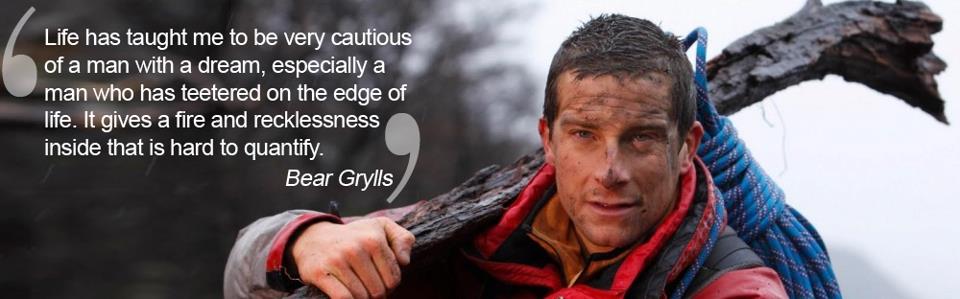
Modesty, Thy Name is Bear Grylls


I just finished reading a book. An autobiography of a person I admire and who has inspired me over the past few years. Bear Grylls. The man behind Man vs Wild. The man who was part of the elite SAS Corps. The man who has spawned a whole new genre of television programming. And why just television programming? The Man vs Wild series has spawned a whole new lifestyle among people all over the world. Adventure and survival has come into our living rooms and more and more people are venturing out into the wilderness with the knowledge that has been inspired by Bear Grylls.

The book makes fascinating reading. It is an extremely easy read and written from the heart. Having seen the Man vs Wild series multiple times and through that having started to understand the essence of the Bear Grylls psyche and character, I very much doubt whether the book was dictated to an editor and published under Bear’s name. No, I do not think that at all. Like Bear says in his Epilogue, the book has been written by him and much of it on flights that he takes around the world, whether filming or on the lecture circuit. It is written from the heart and the inner soul of Bear Grylls the person is exposed, naked to the world, to see him as he really is. A person like any other person we come across on the street. The only difference being his dogged determination and the acceptance of the fact that nothing comes easy. All goals worth fighting for come with inherent obstacles. The harder the task, the more glorious the goal, the more difficult the pitfalls that come on the road to achieving that purpose.

For a person to have had a near fatal accident from a skydive, to have come back and scaled Mt Everest, to doing the kind of things he does on television, is indeed something worth appreciating and getting inspired by. But more than his exploits what hit me on every page of the book was his modesty. He need not have been as modest as he has been in the book. His growing up years, his relationship with his family, the modest beginnings, his love for Shara his wife and their three sons, the way he acknowledges the help he received from friends, all come through wafting through the pages like a rose. He has not failed to recognise those who helped him get up when he believed that he could not rise again. He knows he is not the best soldier or the finest adventurer or the most knowledgeable survivor in the whole wide world. He believes that luck had a whole lot to play in his success and him becoming a household name around the world. He realises that and accepts that with all humility. Modesty and humility are something that I have taken away from this book.

Bear Grylls has grown in my esteem and I feel proud to have his name as one of my inspirations. Truly, if I can imbibe a little bit of the modesty and humility that Bear portrays and obviously lives by, I would become a better person. Success tends to result in swollen brains and an increase in height to ensure that the head is continuously above the clouds. Far from it as far as Bear is concerned. Hats off to him. And I concede, modesty, thy name is Bear Grylls.